What Is Mormon Row?
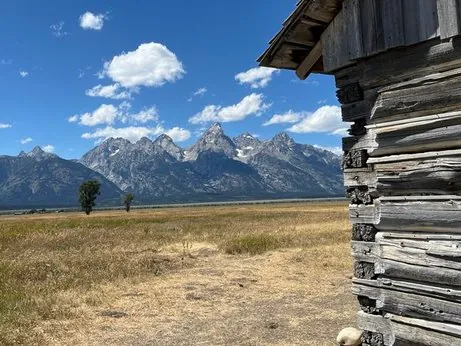
Mormon Row is a line of historic homesteads along a dirt road east of the main highway in Grand Teton National Park, about six miles north of the town of Jackson, Wyoming. The "row" runs along Ditch Creek at the base of the Teton Range, offering what many consider the single most spectacular mountain-and-barn composition in North America.
The settlement was established in the 1890s by a group of Mormon families from the Teton Basin in Idaho — many from the communities around Driggs and Rexburg, not far from Island Park. They were drawn across the Teton Pass by the promise of free land under the Homestead Act, and they stayed to build one of the most resilient agricultural communities in the Northern Rockies.
Today, Mormon Row is listed on the National Register of Historic Places as a historic district. Its remaining structures — especially the T.A. Moulton Barn and John Moulton Barn — are among the most recognizable landmarks in the national park system.
The Arrival of the Settlers (1890s)
The first Mormon settlers arrived in Jackson Hole in 1896, led by families including the Mays, Budges, Moultons, and Henries. They came from the established Latter-day Saint communities in eastern Idaho's Teton Valley.
Under the Homestead Act of 1862, each family could claim 160 acres of public land by living on it for five years, building a dwelling, and "improving" the land through cultivation or irrigation. They chose flat land along Ditch Creek where water was accessible for irrigation — critical at 6,400 feet of elevation with a growing season of barely 60 to 90 days.
By 1908, approximately 27 homesteads had been established along what became known as Mormon Row. The families named the settlement "Grovont" (pronounced "Grow-VONT"), after the nearby Gros Ventre River.
Life on the Row
Life on Mormon Row was defined by brutal winters, relentless physical labor, and a tight-knit community. The settlers raised cattle and horses, grew hay, oats, and barley, and kept vegetable gardens.
Winters regularly dropped to -30°F to -40°F with deep snow. Isolation was extreme — the nearest railroad was over 60 miles away. Supplies had to be stockpiled in autumn. Medical emergencies were handled locally.
Yet the community thrived. Families helped each other build barns, shared equipment, traded labor during haying season, and gathered for dances and weekly church services.
The Iconic Moulton Barns
The two most famous structures on Mormon Row are both Moulton family barns:
T.A. Moulton Barn (c. 1913)
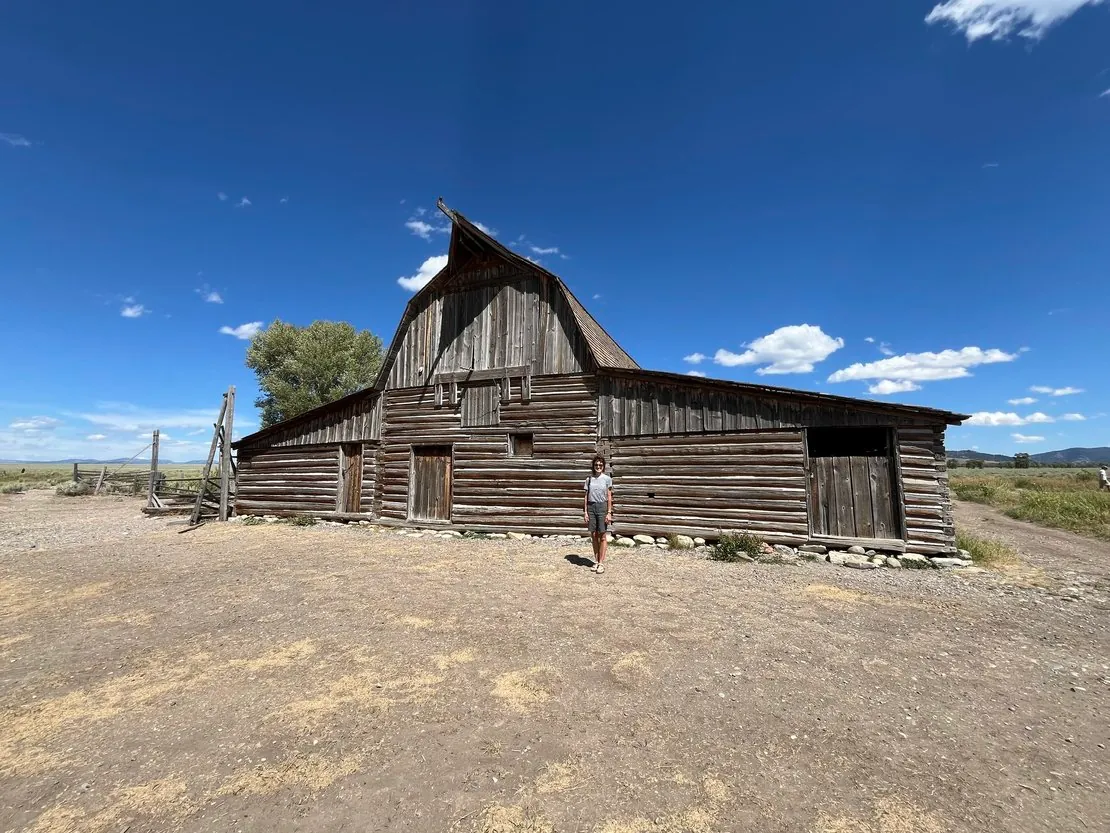
Thomas Alma Moulton began building his barn around 1913 and worked on it for over 30 years. The result is a distinctive structure with visibly different construction phases — hand-hewn logs on the lower level, sawn boards above. This is the barn most commonly seen in photographs, with the full Teton Range rising behind it.
John Moulton Barn (c. 1908)
John Moulton, Thomas's brother, built his barn slightly earlier and closer to the road. It has a more weathered, leaning appearance with a haunting, time-worn quality. Many photographers prefer it for its raw, unvarnished beauty.
Both barns are maintained by the National Park Service as part of the Mormon Row Historic District. They are not open for interior access but visitors can walk around and photograph them freely.
Community, Church & School
The settlers built a small church and community hall that served as the center of social life. Sunday services, community meetings, dances, and holiday celebrations all took place under one roof.
A one-room schoolhouse served the settlement's children through elementary grades. The Grovont community also built a blacksmith shop, operated a small general store, and maintained shared corrals.
Irrigation & Agricultural Ingenuity
One of the most remarkable achievements was the irrigation system. The community dug a network of ditches to channel water from Ditch Creek across their fields — transforming arid sagebrush flats into productive hay meadows.
This was quintessential Mormon pioneering practice. The LDS settlers brought irrigation expertise from Idaho, where similar systems watered farms around the Henry's Fork region.
The irrigation ditches allowed settlers to grow enough hay to sustain 100 to 200 head of cattle per ranch through long winters.
Decline & the Rockefeller Buyout
By the 1920s and 1930s, the community was under pressure. Beef prices collapsed after World War I. The Great Depression made a difficult situation desperate.
Then came the Snake River Land Company — the secret purchasing agent created by John D. Rockefeller Jr. As described in our article on the founding of Grand Teton, Rockefeller's agents began purchasing homesteads, offering prices many struggling ranchers couldn't refuse.
When the expanded Grand Teton National Park was established in 1950, most of Mormon Row fell within the new boundaries. The community slowly faded as the last original settlers passed away.
Preservation & the Historic District
In 1997, Mormon Row was designated a Historic District on the National Register of Historic Places. The designation recognized the settlement as one of the best-preserved examples of a Western homesteading community.
The historic district includes six surviving structures: the two Moulton barns, several outbuildings, and remnant foundations. The National Park Service has undertaken multiple stabilization projects to keep the remaining structures standing.
A Global Photography Icon
The T.A. Moulton Barn is one of the most photographed barns in the world. Its appeal: the rustic, weathered barn sits in a flat sagebrush meadow with the entire Teton Range rising directly behind it.
The composition is especially dramatic at sunrise, when first light hits the Teton peaks while the valley remains in shadow. During peak summer, dozens of photographers line up before dawn along the fence line. The barns have appeared in films, advertisements, and art galleries worldwide.
Visiting Mormon Row Today
📍 Getting There
Mormon Row is on Antelope Flats Road, off Highway 191/89 about one mile north of Moose Junction in Grand Teton National Park. Follow the dirt road east for about 1.5 miles. A park entrance fee is required.
Best time for photography: Arrive 30–45 minutes before sunrise. Summer mornings offer the best light and wildflower foregrounds. Fall brings golden cottonwoods.
Wildlife: The Antelope Flats area is one of the best places to see bison, pronghorn, coyotes, and occasionally moose.
Combining with other stops: Mormon Row pairs perfectly with Jenny Lake, Schwabacher Landing, and the Jackson Hole town square. From our Island Park cabin, Mormon Row is about a 90-minute drive south.
It's also an excellent stop on the scenic drive between Yellowstone and Grand Teton.