The Yellowstone Hotspot
The Yellowstone region sits atop a mantle plume — a column of superheated rock rising from deep within the Earth's mantle, independent of tectonic plate boundaries.
Think of it like a geological blowtorch, fixed in place while the North American plate slowly moves southwest over it at about 2.5 cm per year.
As the plate moves, the hotspot burns through the crust in a new location every few hundred thousand years, leaving a chain of volcanic calderas across Idaho, Wyoming, and Montana — a "track" of ancient eruptions stretching back 16 million years.
The current position? Yellowstone National Park.
The Island Park Caldera (2.1 Million Years Ago)
The oldest of the three major Yellowstone super-eruptions created the Island Park Caldera — and if you're staying at Lodgepole Pines Retreat, you're inside it right now.
The caldera is massive:
- 18 miles wide by 23 miles long
- Covers most of Island Park, Idaho
- Visible from space (if you know what to look for)
The eruption that formed it — the Huckleberry Ridge eruption — was one of the largest volcanic events in Earth's history.
The Huckleberry Ridge Eruption
Age: 2.1 million years ago
Volume: ~2,500 cubic kilometers of material ejected
🌋 Scale of Destruction
To put 2,500 km³ in perspective: that's about 2,500 times larger than the 1980 Mount St. Helens eruption. Ash from this eruption has been found in California, Louisiana, and Mexico.
The eruption was so massive it caused the ground to collapse, forming the caldera that defines Island Park's geography today. The Henry's Fork of the Snake River flows through the caldera's western edge. Mesa Falls sits on its rim.
If you drive US-20 between Ashton and West Yellowstone, you're driving through the caldera floor.
The Henry's Fork Caldera (1.3 Million Years Ago)
The second major eruption — the Mesa Falls eruption — occurred 1.3 million years ago, creating the Henry's Fork Caldera.
Volume: ~280 km³ (smaller than Huckleberry Ridge, but still a super-eruption)
This caldera is nested partially inside the older Island Park Caldera. The deposits from this eruption created the cliffs around Mesa Falls and much of the welded tuff (volcanic rock) you see throughout the region.
The Yellowstone Caldera (640,000 Years Ago)
The most recent super-eruption — the Lava Creek eruption — created the modern Yellowstone Caldera.
Age: 640,000 years ago
Volume: ~1,000 km³
Size: 30 miles by 45 miles
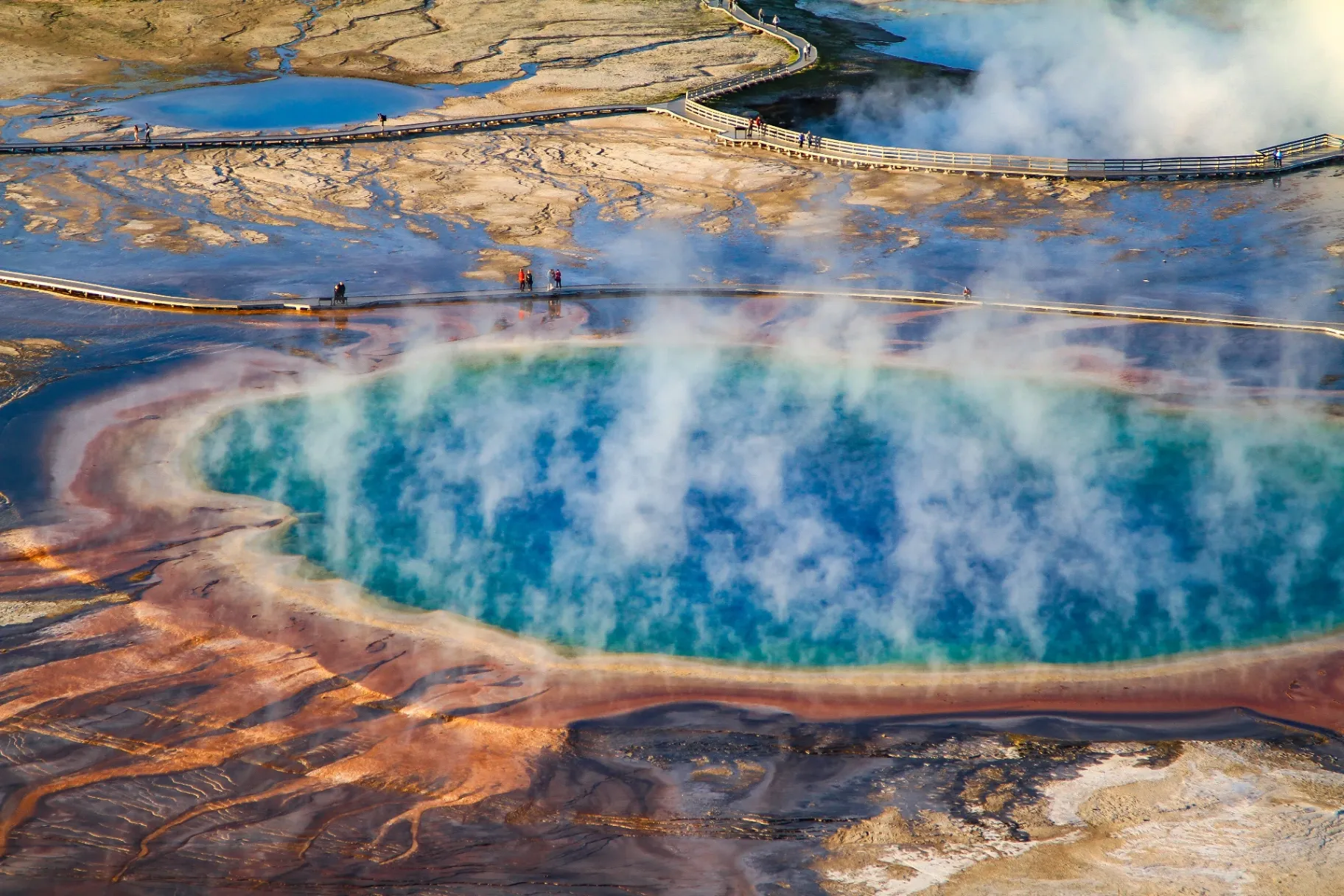
This caldera defines the modern park. Yellowstone Lake partially fills it. The famous geysers (Old Faithful, Grand Prismatic, Norris) all sit within or on its edges.
The eruption blanketed half of North America in volcanic ash. Ash deposits several feet thick have been found as far east as Mississippi.
The Three Super-Eruptions Compared
| Eruption |
Age |
Volume (km³) |
Caldera |
| Huckleberry Ridge |
2.1 million years |
~2,500 |
Island Park Caldera |
| Mesa Falls |
1.3 million years |
~280 |
Henry's Fork Caldera |
| Lava Creek |
640,000 years |
~1,000 |
Yellowstone Caldera |
For comparison: Mount St. Helens (1980) ejected ~1 km³.
Living Inside a Caldera
When you stay at Lodgepole Pines Retreat, you're literally sleeping on the floor of the Island Park Caldera — ground zero of a 2.1-million-year-old super-eruption.
You can't really "see" the caldera like you would a crater. It's too big. But you can see its features:
- The Henry's Fork valley — carved through the caldera floor
- Mesa Falls — where the river drops off the caldera rim
- Big Springs — fed by underground water flowing through volcanic rock
- The flat topography — the caldera floor is noticeably flatter than surrounding terrain
The Geothermal Legacy
All three calderas are still geothermally active. The superheated magma chamber beneath Yellowstone (about 5-10 miles deep) heats groundwater, creating:
- Over 10,000 hydrothermal features in Yellowstone
- ~500 geysers — more than anywhere else on Earth
- Hot springs like Grand Prismatic, Morning Glory Pool, and Mammoth Hot Springs
- Mud pots and fumaroles (steam vents)
This geothermal activity is what makes Yellowstone Yellowstone. Without the volcano, there would be no Old Faithful, no rainbow-colored hot springs, no boiling mud pots.
Will It Erupt Again?
Short answer: Eventually, yes. Soon? Almost certainly not.
The USGS Yellowstone Volcano Observatory monitors the caldera 24/7 using:
- Seismometers (earthquake detection)
- GPS stations (ground deformation)
- Thermal sensors (heat changes)
🔍 What Scientists See
The Yellowstone Caldera "breathes" — the ground rises and falls by several centimeters per year. This is normal. Thousands of small earthquakes happen annually. Also normal. The magma chamber is monitored constantly. No signs of an imminent eruption.
The probability of a Yellowstone super-eruption in your lifetime is roughly 1 in 730,000 — far lower than the risk of a major earthquake in California or a massive asteroid impact.
More likely: smaller eruptions, hydrothermal explosions, or continued earthquake swarms. These happen. But a civilization-ending super-eruption? Not something to worry about on your vacation.
See the Evidence Yourself
You don't need a geology degree to appreciate the supervolcano's legacy. Visit these sites during your stay:
- Mesa Falls — Waterfalls on the caldera rim (15 minutes from our cabin)
- Big Springs — Groundwater flowing through volcanic rock (15 minutes)
- Yellowstone geysers — Old Faithful, Grand Prismatic, Norris Geyser Basin (45-60 minutes)
- Grand Canyon of the Yellowstone — Carved through volcanic tuff (60 minutes)
- Obsidian Cliff — Volcanic glass from ancient lava flows (50 minutes)
Every landscape feature you see — the valleys, the cliffs, the hot springs — was shaped by this volcanic system.
Stay Inside the Caldera
Lodgepole Pines Retreat sits within the Island Park Caldera — ground zero of one of Earth's largest volcanic eruptions. Book your geologic adventure today.
Check Availability
 (source: nps.gov)