 (source: nps.gov)
The Mountain That Resisted
At 13,775 feet, the Grand Teton is not the tallest mountain in Wyoming — but no other peak in the American West has its vertical drama: it rises more than 7,000 feet in a single unbroken sweep from the Snake River, with no foothills to soften the rise. From the floor of Jackson Hole, it looks essentially unclimbable.
For most of the 19th century, that's how it stayed. Mountain men of the fur trade era traveled around the range; ranchers and dude ranch guests admired the skyline. But the summit itself was treated, for decades, as an open question.
The Disputed 1872 Climb
On July 29, 1872, two members of the Hayden Geological Survey — James Stevenson and Nathaniel P. Langford — reported that they had reached the summit of the Grand Teton. Their account stood as the official "first ascent" for more than a quarter century.
But it had problems. Langford described a broad, flat top with room for several men to walk around — but the actual summit of the Grand is a small, sloping platform with steep drops on every side. Modern consensus is that Stevenson and Langford reached the "Enclosure" — itself an impressive achievement — and either turned back from the final pitch or never realized it existed.
The 1898 First Ascent: Owen, Spalding, Shive & Petersen
 (source: nps.gov)
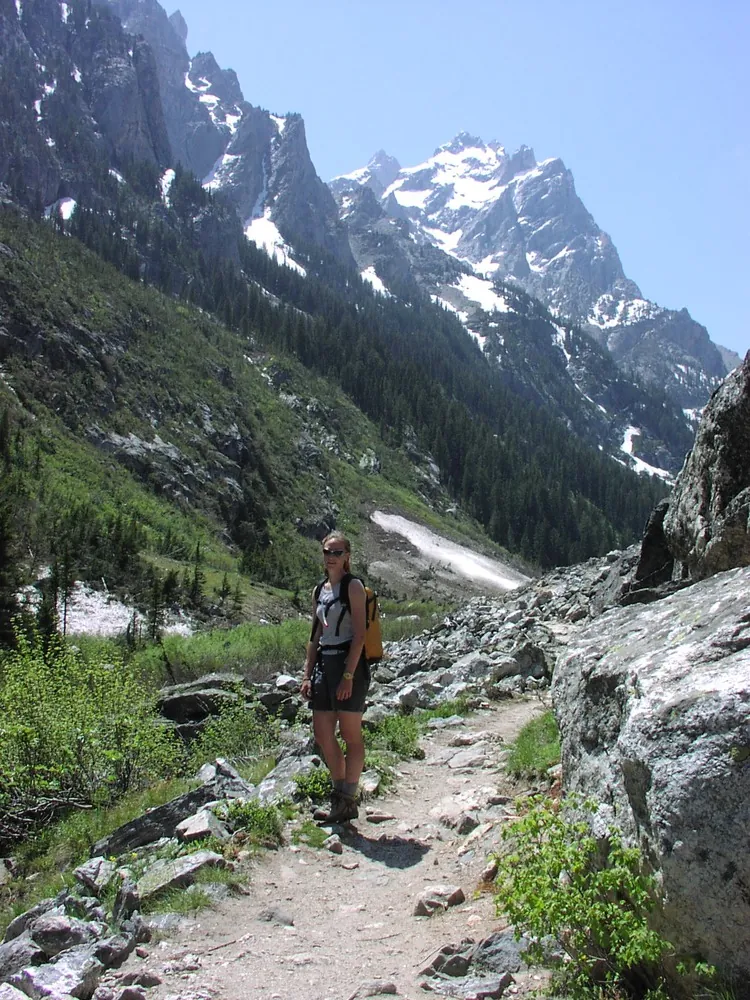
Mount Owen, named for the leader of the 1898 Grand Teton expedition, rises above Cascade Canyon
William O. Owen had attempted the Grand Teton in 1891 and again in 1897, both times turning back. On August 11, 1898, on his fourth attempt, he stood on top. With him were the Reverend Franklin Spalding (the most technically skilled climber of the group); John Shive, an Idaho homesteader; and Frank Petersen. Spalding actually led the crux pitch — a smooth, 65-foot vertical wall now known as the "Belly Roll" and "Crawl" — and was almost certainly the first person to set foot on the true summit.
The Owen–Spalding Route
- • First climbed: August 11, 1898
- • Difficulty: 5.4 (modern Yosemite Decimal System)
- • Length: ~7,000 vertical feet from Lupine Meadows trailhead
- • Standard time: Two days, with a high camp at the Lower Saddle (11,650 ft)
- • Status: Still the most popular route on the Grand Teton
The Owen Petition: Settling the Naming Controversy
William Owen spent the next thirty years arguing — loudly, in print, by petition — that the 1872 Stevenson-Langford ascent was a fabrication and that he, Owen, deserved official recognition. He was almost certainly correct.
In 1929, the year Grand Teton National Park was officially created, the Wyoming State Legislature passed a resolution formally recognizing Owen, Spalding, Shive, and Petersen as the first ascensionists. The 12,928-foot peak directly north of the Grand was named Mount Owen in his honor.
Between the Wars: The Tetons Become a Climbing Range
For 30 years after 1898, the Grand was climbed only sporadically. The arrival of the dude ranch era brought wealthy easterners to Jackson Hole, and some of them wanted more than horseback rides. By the late 1920s, climbing the Grand had become a fashionable challenge — and the dude ranches needed guides who could take guests up.
Glenn Exum & Paul Petzoldt
Paul Petzoldt was 16 years old in 1924 when he and a friend, in cotton overalls and without a rope, made an unguided summit of the Grand Teton. He would later become one of the first Americans to climb in the Himalaya (K2, 1938) and the founder of the National Outdoor Leadership School (NOLS).
Glenn Exum, a music teacher and saxophonist from Idaho, came to the Tetons in 1929 to work for Petzoldt. Two summers later, on July 15, 1931 — alone, unroped, and wearing borrowed football cleats with the spikes filed down — Exum climbed a previously unattempted ridge on the southeast side of the Grand. The route involved a long leap across an exposed gap (the famed "Wall Street" pitch). He was 19. That route — now called the Exum Ridge — has become the most popular way to climb the Grand Teton.
Exum Mountain Guides: America's Oldest Guide School
In 1931, Petzoldt and Exum formalized their guiding operation as the Petzoldt-Exum School of American Mountaineering. After the two parted ways in 1956, Exum continued alone as Exum Mountain Guides. The company is still in business today — the longest continuously operating guide service in North America.
The list of climbers who learned to teach at Exum reads like a roll call of 20th-century American mountaineering: Willi Unsoeld and Tom Hornbein (first Americans up Everest's West Ridge, 1963), Yvon Chouinard (founder of Patagonia and Black Diamond), Jack Tackle, Alex Lowe, and dozens more.
The North Face, 1936
By the mid-1930s the easier routes had been climbed and attention turned to the Grand Teton's most intimidating wall: the North Face. Steep, shaded, ice-rimed even in summer, and 2,500 feet tall, it was the great unsolved problem of the range.
On August 25, 1936, four climbers — Paul and Eldon Petzoldt, Jack Durrance, and Hans Wittich — completed the first ascent of the North Face. The climb was a multi-day epic and an enormous leap forward in American technical climbing.
Modern Routes: From Direct North Face to Black Ice
Yvon Chouinard and Fred Beckey put up the Direct North Face route in 1957. The Black Ice Couloir, a steep ice climb on the northwest face of the Grand, became a benchmark winter ascent. By the 1970s, Jackson Hole had become — and remains — one of the best small climbing towns in the world. Its proximity to Yellowstone, just a few hours from Island Park by car, made the Greater Yellowstone region a natural circuit for climbers.
Climbing the Grand Today
Several thousand people summit the Grand Teton each year. Most go up the Owen–Spalding (the easier original route) or the Exum Ridge (the classic). Both are typically done in two days, with a high camp at the Lower Saddle at 11,650 feet. Most non-climbers who summit do so with a permitted guide service.
Permitted Guide Services on the Grand Teton
- • Exum Mountain Guides — operating since 1931
- • Jackson Hole Mountain Guides — founded 1968
- • Typical cost: Roughly $1,800–$2,500 per person for a guided two-day summit (verify current pricing)
- • Skill prerequisite: Most guide services require a one-day rock climbing course before attempting the summit
Pricing and availability change yearly — confirm directly with the guide services. The National Park Service publishes current climbing regulations and seasonal closures at nps.gov/grte.
For visitors who want to experience the Tetons without ropework, the hiking trails of Cascade and Paintbrush canyons travel directly beneath the Grand and offer some of the best views of the climbing routes themselves.