The Island Park Caldera: One of Earth's Largest Volcanic Calderas
10 min read · Updated June 2026
What Is the Island Park Caldera?
When most people think "Yellowstone supervolcano" they picture the famous Yellowstone Caldera inside the national park. Few realize that the western half of Island Park, Idaho is itself the floor of an even larger, older caldera — the Island Park Caldera. It measures roughly 18 by 23 miles, covers about 415 square miles, and is one of the largest well-preserved calderas on Earth.
When you drive US-20 from Ashton to West Yellowstone, you spend most of that climb crossing the floor of this caldera. The reason the country is so flat, so wet, and so full of springs is because the caldera floor is a porous sponge of volcanic ash and rhyolite holding enormous amounts of groundwater.
Three Supereruptions on the Hotspot Track
The Island Park Caldera is the middle of three colossal eruptions on the Yellowstone hotspot track:
- Huckleberry Ridge eruption — ~2.1 million years ago. The largest of the three; ejected an estimated 2,500 km³ of material.
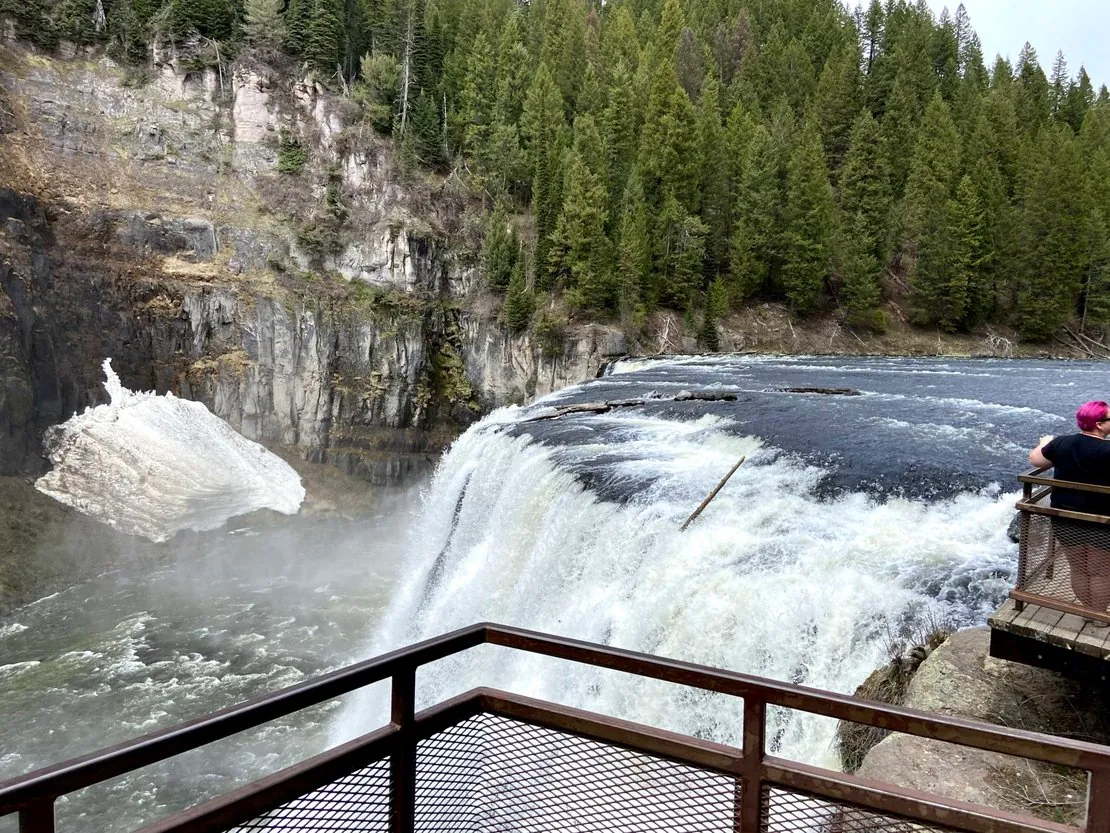
- Mesa Falls eruption — ~1.3 million years ago. Produced the Island Park Caldera and laid down the Mesa Falls Tuff visible at Upper Mesa Falls.
- Lava Creek eruption — ~640,000 years ago. Formed today's Yellowstone Caldera inside the national park.
For the broader story of the still-active magma system to the east, see The Yellowstone Supervolcano.
The Rim You Can Actually See
The Island Park Caldera's western and southern rims are unusually intact for a feature this old. The most photogenic segment is Big Bend Ridge, the long arcing ridgeline visible west of US-20 between Macks Inn and Last Chance — that ridge is the caldera wall. The southern rim runs along Bishop Mountain, and the Henry's Fork famously pours over it in two stages at the Mesa Falls — see Upper & Lower Mesa Falls.
How the Caldera Shaped the Henry's Fork
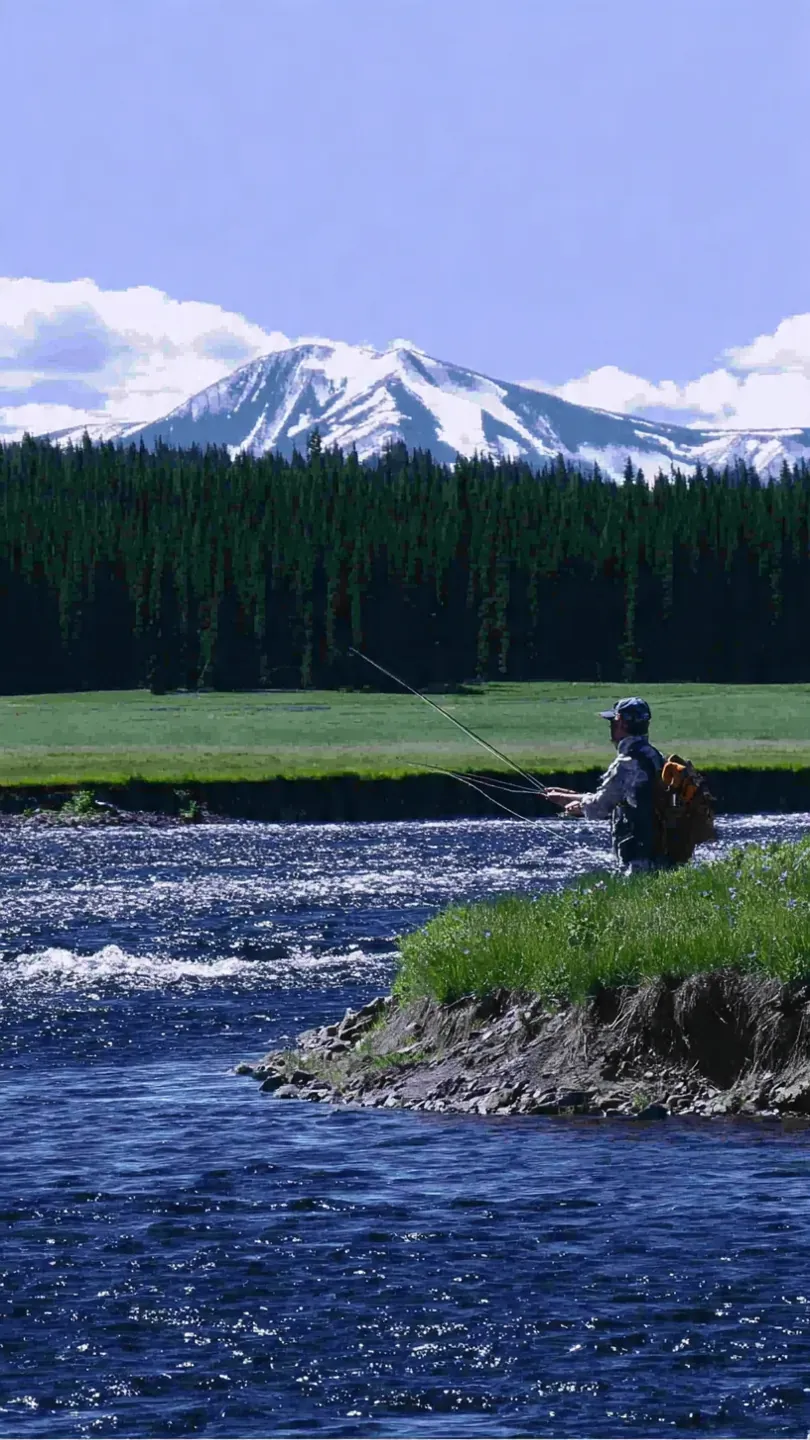
Almost every defining feature of Island Park traces back to the Mesa Falls eruption. The porous volcanic floor stores groundwater and releases it as huge cold springs — most famously Big Springs, the source of the Henry's Fork, which discharges roughly 120 million gallons per day at a constant 52°F. Those same spring-fed flows make the Henry's Fork world-famous for fly fishing — see History of Fly Fishing the Henry's Fork.
The flat caldera floor also gave the railroad an easy grade through the country — see Railroad History of Island Park.
Island Park vs. Yellowstone Caldera
The two calderas overlap — the eastern edge of the Island Park Caldera sits inside what later became the western half of the Yellowstone Caldera. The simplest mental picture: the Yellowstone hotspot has punched a new caldera roughly every 700,000 years as the North American plate drifted southwest over it. Island Park is the one before last; Yellowstone is the most recent.
Where to Experience the Caldera
Upper Mesa Falls
Water pouring over the caldera rim; the Mesa Falls Tuff is literal evidence of the 1.3 Ma eruption. See Mesa Falls history.
Big Springs
120 million gallons/day flowing out of the caldera floor; pair with Johnny Sack Cabin.
Big Bend Ridge overlook (US-20)
The most obvious visible rim segment.
Harriman State Park
Sits entirely on the caldera floor; trumpeter swan and elk habitat tied to the wet, spring-fed landscape.
Island Park Reservoir
Impounded on the caldera floor; popular for boating and fishing.
Build a half-day caldera tour by stringing these stops together — see Island Park maps and our trip planning hub.
Eruption ages and volumes follow published USGS Yellowstone Volcano Observatory figures and may be revised as research continues.
Related Articles
Stay on the Caldera Floor
Lodgepole Pines Retreat sits squarely inside the Island Park Caldera — minutes from Big Springs, Mesa Falls, and the Big Bend Ridge overlook. Sleeps 12 — book direct and save up to 10%.
Book Your Stay — Save 10%