At least 27 tribes have deep connections to Yellowstone stretching back 11,000 years — from obsidian trade networks and Sheepeater camps to the Nez Perce flight and modern tribal reconnection.
(source: nps.gov)
11,000 Years of Human History
Long before Yellowstone became "America's first national park" in 1872, it was home to people. Archaeological evidence reveals continuous human presence stretching back at least 11,000 years — to the end of the last Ice Age, when Clovis-era hunters tracked mammoth and bison across the Yellowstone Plateau.
The oldest known archaeological site in the park, near the north shore of Yellowstone Lake, contains Clovis projectile points made from local obsidian — evidence that some of North America's earliest people not only passed through this landscape but knew it intimately.
Tribes Connected to Yellowstone
The National Park Service recognizes at least 27 present-day tribes with historical connections to the lands now within Yellowstone, including:
Eastern Shoshone (Tukudika / Sheepeaters) — Year-round residents of the Yellowstone Plateau
Crow (Apsáalooke) — Whose traditional territory included the Yellowstone River valley
Blackfeet (Niitsítapi) — Powerful Plains warriors bordering Yellowstone to the north
Bannock — Who traveled an ancient trail through the park each summer
Nez Perce (Niimíipuu) — Whose 1877 flight through the park became legendary
Flathead (Salish) — Who hunted in the western valleys near the park
Obsidian Cliff & the Ancient Trade Networks
(source: nps.gov)
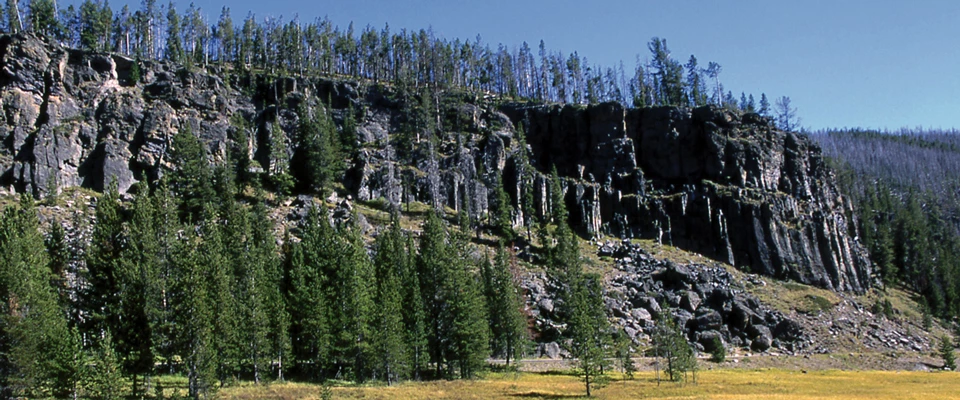
Yellowstone's Obsidian Cliff, located between Mammoth Hot Springs and Norris, is one of the most significant archaeological sites in North America. This massive outcrop of volcanic glass was the continent's premier source of obsidian.
Obsidian from this cliff has been found in archaeological sites more than 1,500 miles from its source — evidence of vast trade networks connecting dozens of cultures for thousands of years. The cliff was designated a National Historic Landmark in 1996.
The Tukudika — Yellowstone's Year-Round Residents
While most tribes used Yellowstone seasonally, one group lived there year-round: the Tukudika, a band of Eastern Shoshone also called the "Sheepeaters." They were masters of high-altitude survival, building wickiup shelters and crafting exceptional bows from bighorn sheep horn.
Archaeological surveys have documented over 1,800 sites within Yellowstone National Park — wickiup remains, fire hearths, tool-making workshops, and rock shelters that speak to continuous occupation at elevations above 8,000 feet.
Displacement & the Park Idea
The creation of Yellowstone National Park in 1872 was, among other things, an act of dispossession. The park's founding narrative deliberately erased Indigenous history — presenting the land as an "uninhabited wilderness."
The Tukudika Sheepeaters were removed in the late 1870s. The Bannock were barred from their traditional hunting routes. Superintendent Philetus Norris actively campaigned to remove all Native Americans from the park.
The Nez Perce Flight of 1877
In August 1877, approximately 750 Nez Perce — led by Chief Joseph, Looking Glass, and other leaders — fled through the park during their epic 1,170-mile retreat from the U.S. Army. Over 13 days, they navigated the Yellowstone backcountry.
The flight ended tragically at the Battle of the Bear Paw in Montana, just 40 miles from the Canadian border. Chief Joseph's surrender speech — "From where the sun now stands, I will fight no more forever" — remains one of the most quoted passages in American history.
The Bannock Trail & Forced Removal
For generations, the Bannock people traveled an ancient trail through what is now Yellowstone to reach bison hunting grounds. This trail was so well-worn that early explorers described it as a "broad, deeply rutted path."
After the Bannock War of 1878, the Bannock were confined to the Fort Hall Reservation near present-day Island Park and barred from their traditional hunting routes.
The Myth of the Uninhabited Wilderness
For more than a century, Indigenous peoples were treated as footnotes in Yellowstone's history. Modern scholarship has thoroughly debunked this myth — the 1,800+ archaeological sites, the obsidian trade networks, the Tukudika wickiups, and the oral histories of dozens of tribes all tell the same story: Yellowstone was deeply known and spiritually significant to Indigenous peoples for thousands of years.
📺 A brief history of Yellowstone — National Geographic
Modern Tribal Reconnection
In recent decades, the NPS has formally recognized 27 associated tribes through consultation agreements. The park now hosts cultural events, traditional plant gathering, and collaborative research with tribal historians. Tribal nations have also advocated for the return of traditional place names and restoration of treaty-guaranteed access rights.
Visiting These Sites Today
Obsidian Cliff — Pull off along the Grand Loop Road between Mammoth and Norris
Indian Creek Campground area — Near the Bannock Trail route
Yellowstone Lake shoreline — Oldest archaeological sites (11,000 years)
Lamar Valley — Part of the Nez Perce flight route
Museum of the National Park Ranger at Norris — Exhibits on Indigenous presence
 (source: nps.gov)