 (source: nps.gov)
Discovery & Naming: The 1870 Washburn Expedition
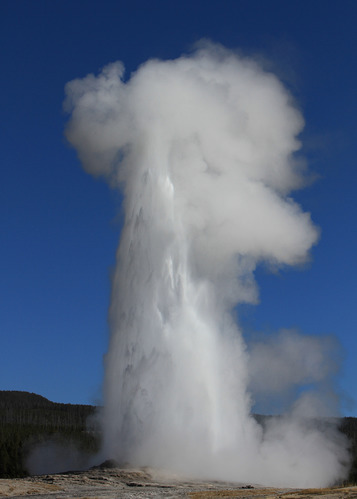
On September 18, 1870, members of the Washburn–Langford–Doane Expedition — a 19-man party of Montana civic leaders and a U.S. Army escort — camped along the Firehole River in what is now the Upper Geyser Basin. They had already spent weeks exploring Yellowstone's wonders, but nothing prepared them for the concentration of geysers they encountered here.
Nathaniel P. Langford, the expedition's chronicler, recorded in his journal that one particular geyser erupted with such regular frequency that they could predict its next performance. General Henry D. Washburn reportedly declared: "I name thee Old Faithful." It was the first geyser in the park to receive a name, and it remains the most famous geyser on Earth.
The following year, the 1871 Hayden Geological Survey — the expedition that ultimately led to Yellowstone becoming the world's first national park — brought scientific instruments to measure geyser intervals for the first time. Ferdinand Hayden's team catalogued dozens of geysers, and photographer William Henry Jackson captured the first photographs of Old Faithful.
Why "Old Faithful"?
Contrary to popular belief, Old Faithful is neither the tallest, largest, nor most frequent geyser in Yellowstone. Its fame rests on a single quality: predictability. In 1870, the expedition observed it erupting roughly every 60–65 minutes. Today the average interval is about 92 minutes — it has slowed over 150 years — but it remains the most reliably predictable large geyser on Earth.
Old Faithful: The World's Most Famous Geyser
 (source: nps.gov)
By the Numbers
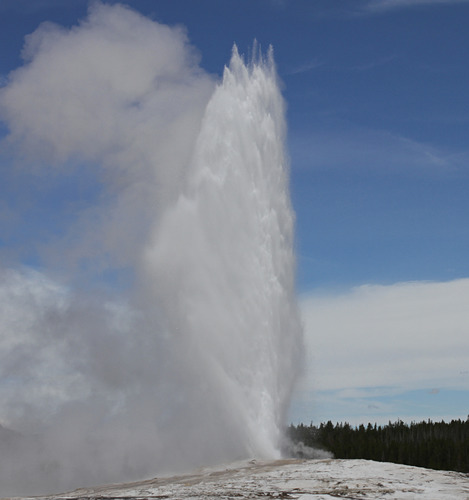
Old Faithful is a cone geyser, meaning its eruptions shoot from a raised mound of siliceous sinter (geyserite) deposited over thousands of years. The cone stands about 6 feet high and is surrounded by a broad apron of geyserite.
Each eruption lasts between 1.5 and 5 minutes. A key discovery: the duration of each eruption predicts the interval until the next one. A short eruption (under 2.5 minutes) is followed by ~65 minutes; a long eruption (over 4 minutes) means ~92 minutes. Rangers use this to post predictions accurate within 10 minutes roughly 90% of the time.
Since record-keeping began in the 1870s, Old Faithful has erupted more than one million times. Its interval has gradually lengthened — from about 60 minutes in the 1870s to about 92 minutes today — likely due to the 1959 Hebgen Lake earthquake (magnitude 7.3), which altered underground water flow paths.
Winter Eruptions
 (source: nps.gov)
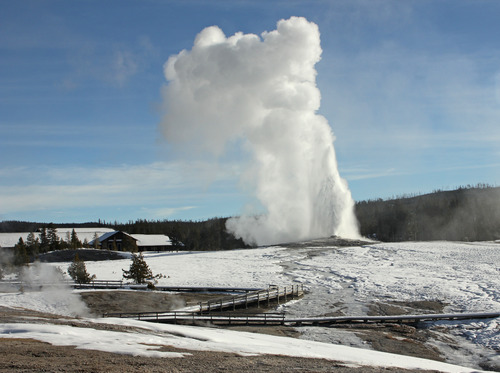
Some of Old Faithful's most dramatic performances happen in winter, when eruptions create massive columns of steam against sub-zero temperatures. Winter visitors can reach Old Faithful by snowcoach or guided snowmobile tours — one of the most magical experiences in all of Yellowstone.
The Underground Plumbing System
What makes Yellowstone the geyser capital of the world? Three ingredients: intense underground heat, plentiful water supply, and a specialized plumbing system of fractures and cavities. Yellowstone has all three thanks to the supervolcano beneath the surface.
In 2015, University of Utah seismologists used seismic interferometry to image Old Faithful's plumbing — a reservoir chamber 45–65 feet below the surface, shaped like a bent funnel, with a diagonal conduit to the vent. Groundwater heated by magma as shallow as 3–5 miles reaches 400°F+ before rising through the system.
When superheated water reaches a constriction point, pressure drops cause flash boiling that cascades through the column, propelling thousands of gallons skyward at speeds exceeding 200 mph.
Why Are Geysers So Rare?
Of roughly 1,000 geysers on Earth, more than half — about 500 — are in Yellowstone. They require fractured rock creating pressure-sealed conduits, intense near-surface heat, and abundant groundwater. Even tiny earthquake-caused changes can create new geysers or silence existing ones overnight.
Upper Geyser Basin: The Greatest Geyser Field on Earth
 (source: nps.gov)
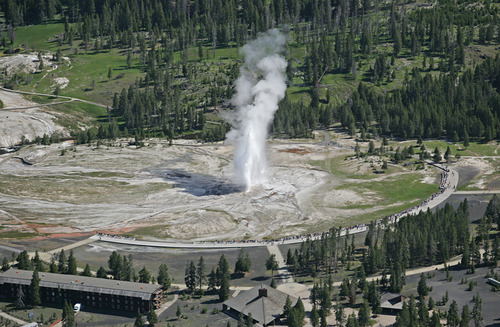
The Upper Geyser Basin contains the largest concentration of geysers anywhere on the planet. Within one square mile: approximately 150 geothermal features, including at least five major predictable geysers (Old Faithful, Castle, Grand, Daisy, and Riverside).
A 3-mile boardwalk network makes it one of the most accessible geothermal areas in the world. For a detailed walking route, see our Best Things to Do in Yellowstone guide and 3-Day Yellowstone Itinerary.
Castle Geyser: The Ancient Giant
Castle Geyser may be the oldest geyser in Yellowstone. Its massive cone has been carbon-dated to approximately 5,000–15,000 years old. The crenellated top resembles a medieval castle's battlements, earning its name from the 1870 Washburn Expedition.
Castle erupts on average every 14 hours. Its water phase lasts ~20 minutes and reaches ~75 feet, followed by a steam phase lasting 30–40 minutes that produces dramatic roaring sounds audible across the basin.
Geologists have determined that Castle sits atop even older sinter platforms, suggesting continuous geothermal activity at this location for tens of thousands of years.
Grand Geyser: The World's Tallest Predictable Geyser
Grand Geyser holds the title of the tallest predictable geyser on Earth, with eruptions reaching 150–200 feet. It erupts roughly every 6–7 hours in spectacular "bursts" — sometimes two, three, or four bursts per event.
Grand is a fountain geyser (erupting from a pool rather than a cone). The surrounding Grand Group includes Turban Geyser and Vent Geyser, which interact in complex ways — Turban's eruptions serve as a precursor, allowing experienced geyser gazers to predict Grand with surprising accuracy.
Beehive Geyser: The Showstopper
 (source: nps.gov)
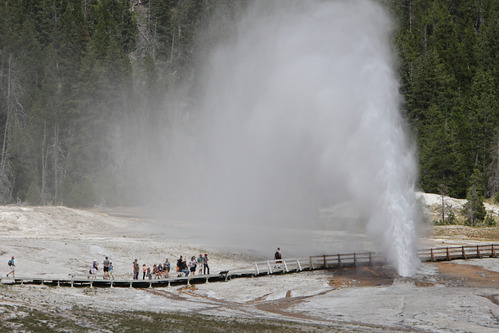
Named for its 4-foot-tall cone resembling a straw beehive, Beehive Geyser propels water to 150–200 feet through an opening barely 4 inches wide. It erupts roughly every 10–20 hours.
The key to catching Beehive is its Indicator — a companion vent that begins spraying 10–25 minutes before the main eruption. When seasoned watchers see it start, word spreads quickly. The resulting 5-minute eruption often draws spontaneous applause.
Grand Prismatic Spring: Yellowstone's Largest Hot Spring
 (source: nps.gov)
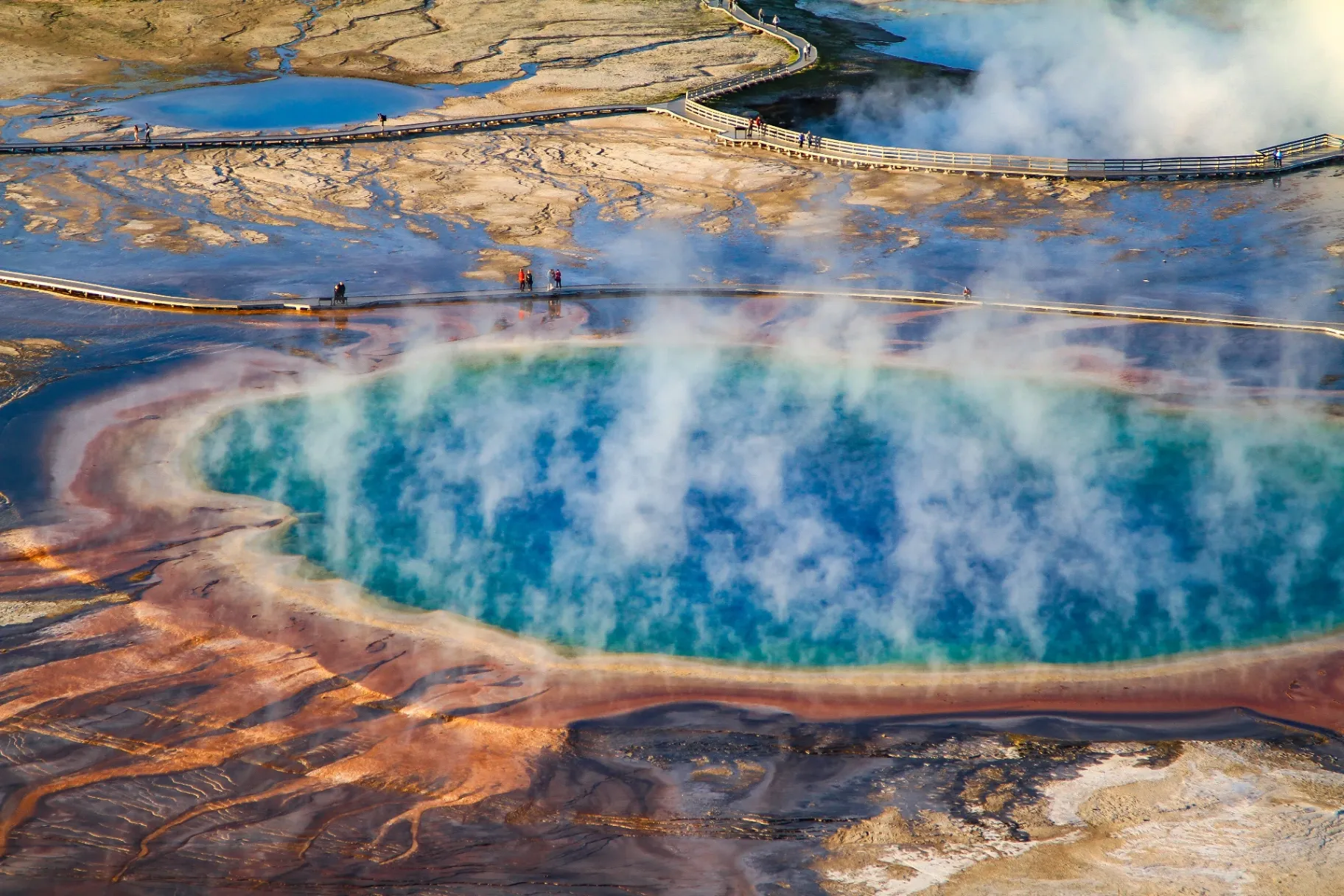
Grand Prismatic Spring is the largest hot spring in the United States — approximately 370 feet in diameter and over 121 feet deep, the third-largest in the world.
The vivid rainbow colors are caused by thermophilic bacteria thriving at specific temperatures. The center at ~188°F appears deep blue; successive rings of pigmented bacteria create the prismatic effect as water cools outward.
The name was given by the Hayden Expedition in 1871. The best overhead view is from the Grand Prismatic Overlook trail, a short 0.8-mile hike. Grand Prismatic discharges an estimated 560 gallons per minute into the Firehole River.
Beyond Old Faithful: Other Geyser Basins
Yellowstone contains at least nine major geyser basins:
Midway Geyser Basin
Home to Grand Prismatic Spring and Excelsior Geyser Crater. Small but incredibly dramatic.
Lower Geyser Basin
Yellowstone's largest basin by area, featuring Fountain Paint Pots and Great Fountain Geyser (100-ft eruptions).
Norris Geyser Basin
The hottest and most dynamic basin, with Steamboat Geyser — the world's tallest active geyser (300+ feet).
West Thumb Geyser Basin
Geothermal features on the shore of Yellowstone Lake where hot springs discharge into the cold lake water.
Mammoth Hot Springs
Terraced limestone formations — a completely different geothermal system from the silica-based geysers.
See our 3-Day Itinerary for optimal routing and our crowd avoidance guide for the best times to visit.
Old Faithful Inn: The World's Largest Log Hotel
 (source: nps.gov)
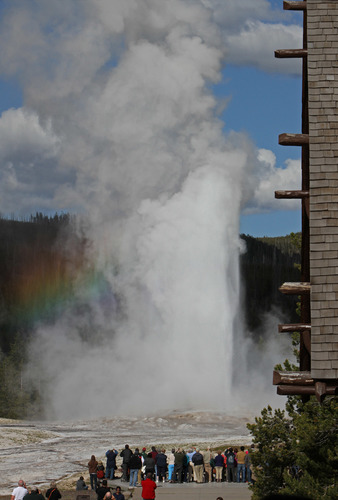
Built in 1903–1904, the Old Faithful Inn is a National Historic Landmark. Architect Robert C. Reamer, only 29, created a masterpiece of rustic architecture that influenced national park lodge design for the next century.
The "Old House" features a 76-foot-tall lobby with a massive rhyolite fireplace and lodge-pole pine columns. Two wings added in 1913 and 1927 brought the room count to 327. The Inn survived the 1988 fires when firefighters placed sprinklers on the cedar-shake roof.
For a comfortable base near Yellowstone, see Lodgepole Pines Retreat, just 45 minutes from Old Faithful.
How Yellowstone's Geysers Change Over Time
Yellowstone's geothermal features constantly evolve. Notable changes:
- Excelsior Geyser — Once the world's most powerful (300 feet in the 1880s), now a massive hot spring discharging 4,050 gallons per minute.
- Steamboat Geyser — 300+ foot eruptions at intervals from 3 days to 50+ years. Between 2018–2020, it had 48 eruptions in one year.
- 1959 Hebgen Lake Earthquake (M 7.3) — Created new hot springs, silenced some geysers, lengthened Old Faithful's interval.
- Morning Glory Pool — Colors shifted from deep blue to green/yellow after decades of visitors throwing coins and debris.
- 1988 fires — Minimal direct effect on geothermal features, demonstrating the geyser system operates independently of surface conditions.
Learn more in our Yellowstone Supervolcano deep-dive.
Visiting the Geysers Today
 (source: nps.gov)
Practical Tips
- Check eruption predictions at the Visitor Education Center or NPS app.
- Arrive early — parking fills by 10–11 AM in summer. Enter via the West Entrance before 9 AM.
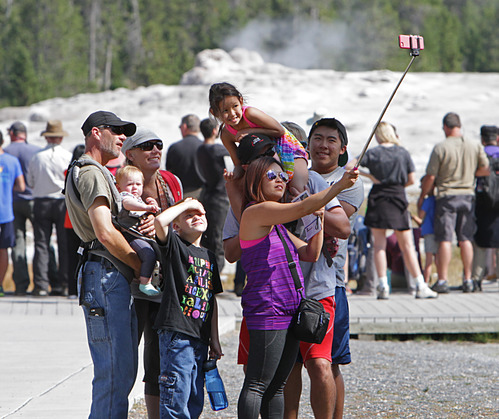
- Walk the full boardwalk — Most visitors only see Old Faithful and leave. The 3-mile loop passes Castle, Grand, Beehive, and dozens more.
- Stay on boardwalks — Thin crust can conceal boiling water inches below. See our safety guide.
- Visit in winter — Fewer visitors, better photography. Winter Guide →
Getting There from Lodgepole Pines
Old Faithful is approximately 65 miles (~1.5 hours) from our cabin via the West Entrance. The drive passes Fountain Paint Pots, Midway Geyser Basin, and dozens of roadside thermal features. See our driving guide and best time to visit for timing tips.