When do Yellowstone's roads open? It depends — and the answer changes every year. Yellowstone's road system opens in phases between mid-April and late May, with exact dates driven by snowpack depth, plowing progress, and safety inspections. Planning a spring trip means understanding which roads will be accessible on your dates and which will still be buried under 10+ feet of snow.
This guide covers the 2026 plowing schedule, road-by-road opening timelines, what "open" actually means in spring, the Beartooth Highway, wildlife traffic jams, vehicle requirements, and strategies for making the most of an early-season visit.
For a complete month-by-month breakdown of crowds, weather, and wildlife, see our Best Time to Visit Yellowstone guide.
Quick Opening Summary
Here's the at-a-glance timeline for Yellowstone's seasonal road openings. Exact dates are set by the NPS each year and can shift by days or weeks depending on conditions.
| Road / Entrance | Typical Opening |
|---|---|
| North Entrance (Mammoth to Cooke City)Year-round | Year-round |
| West Entrance to Madison | Third Friday in April |
| Madison to Old Faithful | Third Friday in April |
| Madison to Norris | Third Friday in April |
| Norris to Canyon Village | Late April – Early May |
| Canyon to Lake (Hayden Valley) | Early – Mid May |
| Lake to East Entrance | Early – Mid May |
| Old Faithful to West Thumb (Craig Pass) | Early – Mid May |
| South Entrance (Grand Teton Connection) | Mid May |
| Tower to Canyon (Dunraven Pass) | Late May – Early June |
| Beartooth Highway (NE Entrance to Red Lodge) | Late May – Early June |
⚠ Always Check Before You Go
Opening dates are targets, not guarantees. Spring storms can delay openings or temporarily close roads after they've opened. Check nps.gov/yell road status the morning of your visit. Also see our Maps & Live Conditions page for quick links.
2026 Road-by-Road Opening Schedule
Below is a detailed breakdown of every major road corridor. Understanding the sequence helps you plan which areas of the park you can realistically visit on your dates.
🛣 North Entrance (Mammoth to Cooke City)
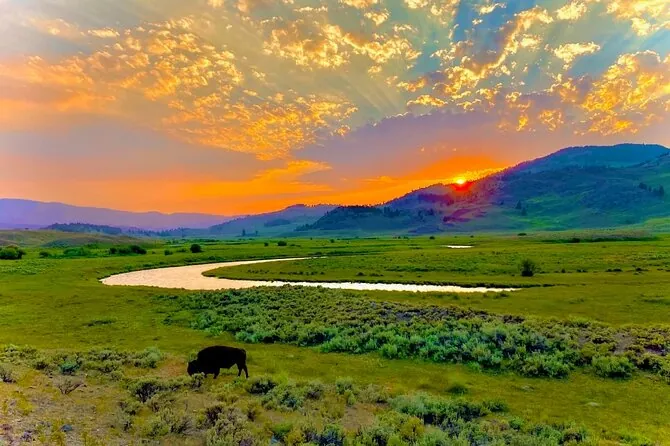
Year-roundThe only road open all winter. Connects Gardiner, MT to Cooke City via Lamar Valley — prime wolf and bison country.
🛣 West Entrance to Madison
Third Friday in AprilTypically the first seasonal entrance to open. Connects West Yellowstone, MT to the Madison Junction.
🛣 Madison to Old Faithful
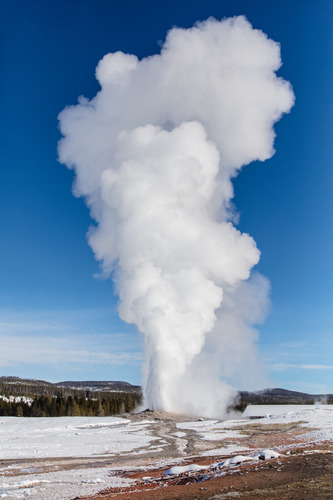
Third Friday in AprilOpens alongside the West Entrance. Provides access to Upper Geyser Basin, including Old Faithful.
🛣 Madison to Norris
Third Friday in AprilOpens on the same date as the West Entrance corridor. Access to Norris Geyser Basin and Gibbon Falls.
🛣 Norris to Canyon Village
Late April – Early MayConnects the western loop to Canyon Village. Opens shortly after the West Entrance roads.
🛣 Canyon to Lake (Hayden Valley)
Early – Mid MayPasses through Hayden Valley — one of the best wildlife corridors. Bear activity is frequent in spring.
🛣 Lake to East Entrance
Early – Mid MayConnects Yellowstone Lake and Fishing Bridge to the East Entrance near Cody, WY.
🛣 Old Faithful to West Thumb (Craig Pass)
Early – Mid MayCrosses the Continental Divide at 8,262 ft. Heavy snowpack can delay opening.
🛣 South Entrance (Grand Teton Connection)
Mid MayConnects Yellowstone to Grand Teton National Park and Jackson, WY. Opens after Craig Pass clears.
🛣 Tower to Canyon (Dunraven Pass)
Late May – Early JuneHighest road in the park at 8,859 ft. Usually the last major road to open. Excellent for spring bear sightings.
🛣 Beartooth Highway (NE Entrance to Red Lodge)
Late May – Early JuneReaches nearly 11,000 ft. Plowing can take weeks. One of the most scenic drives in North America.
Official 2026 Yellowstone Road Maps
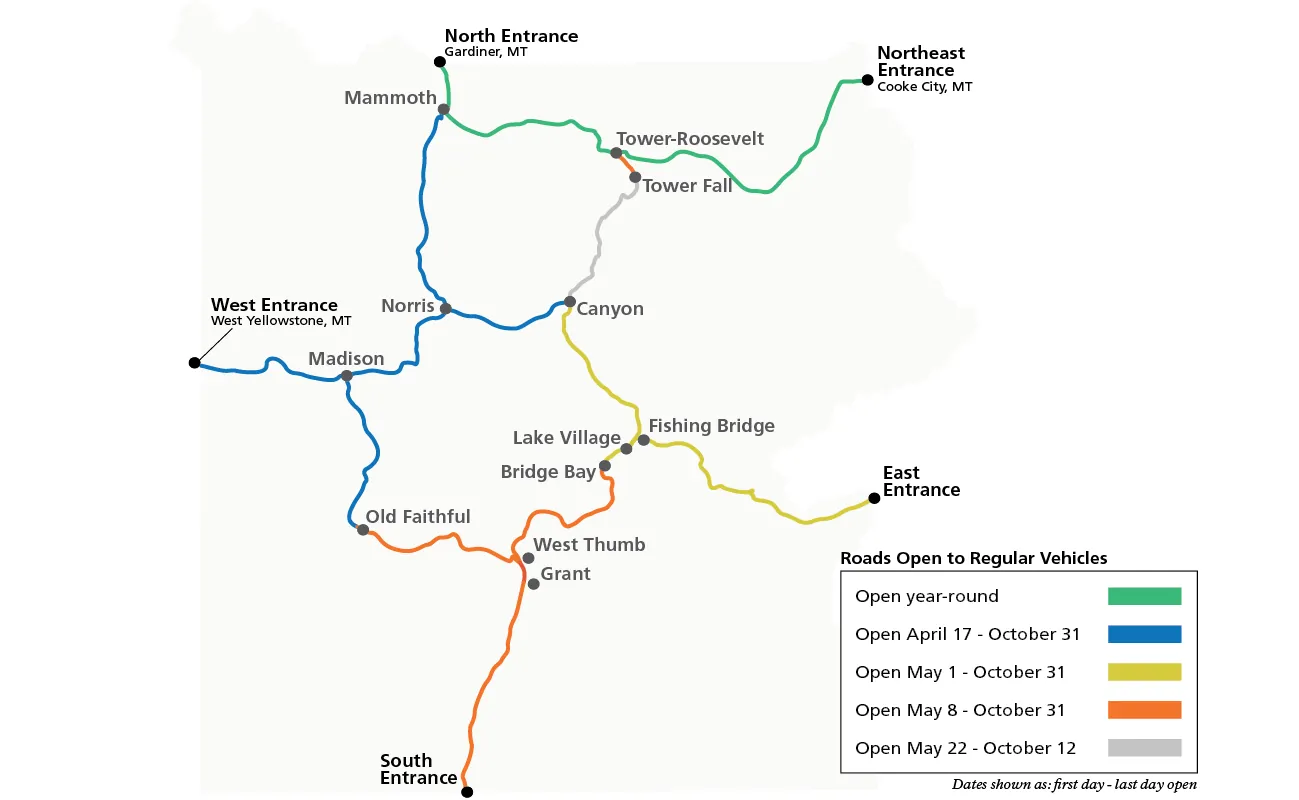
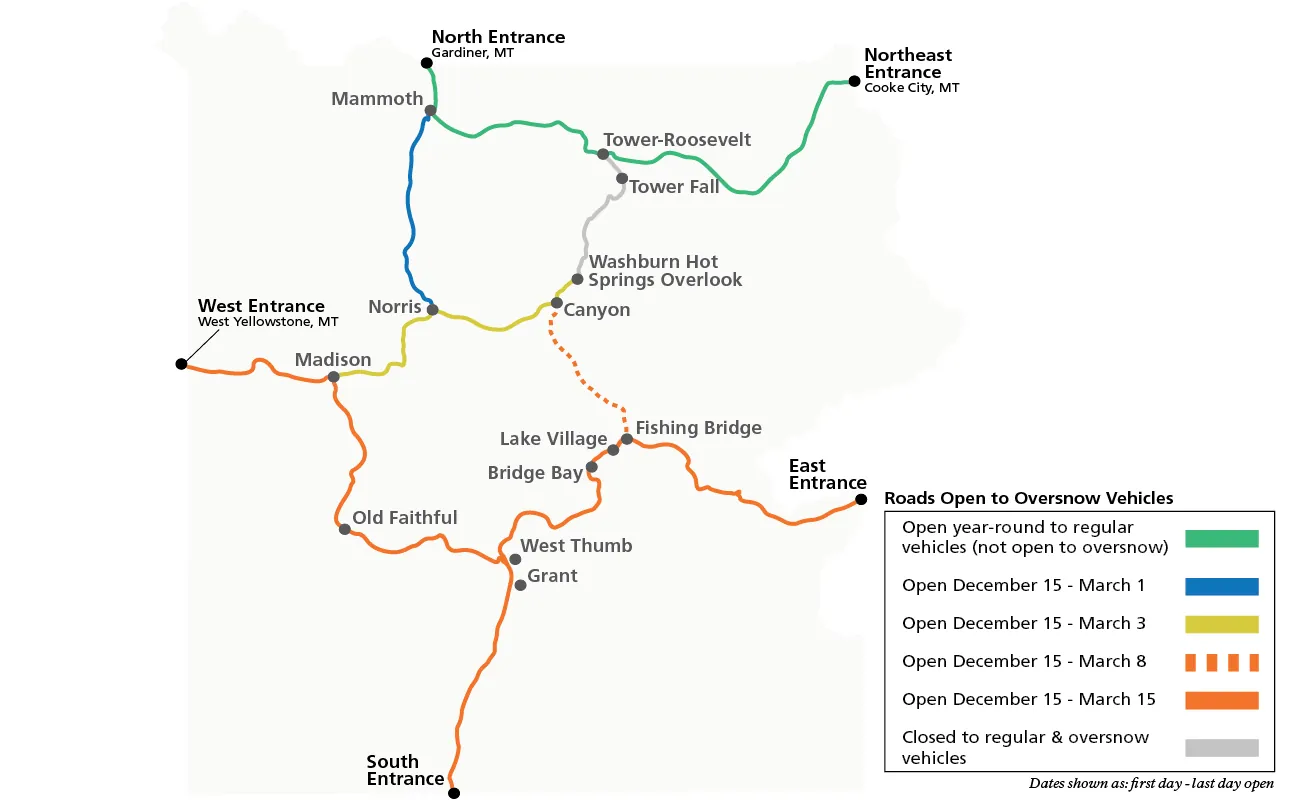
These official National Park Service maps show the 2026 road opening schedules for both regular vehicles and oversnow vehicles.
Regular Vehicle Roads
Oversnow Vehicle Routes
During winter and early spring, certain corridors are accessible only by snowmobile or snowcoach. See our Winter Activities guide.
How Yellowstone Road Plowing Works
Yellowstone doesn't just "open the gates" when winter ends. The park plows and inspects over 300 miles of road in a carefully sequenced operation that typically begins in early March and can take over two months to complete.
❄ Massive Snowpack
Snowbanks along park roads can exceed 10–15 feet in depth. Rotary plows carve through walls of compacted snow, often working 10–12 hours per day.
🔧 Phased Clearing
Plowing follows a priority sequence — the West Entrance corridor first, then progressively higher-elevation passes. Each segment undergoes safety inspections before opening.
⛰ Avalanche Mitigation
High-elevation roads like Dunraven Pass and Sylvan Pass require avalanche control before plowing can begin. Explosive charges trigger controlled slides.
🛡 No Early Openings
Even if weather seems warm and clear, roads cannot open early. Every segment requires completed plowing, structural inspection, and NPS approval.
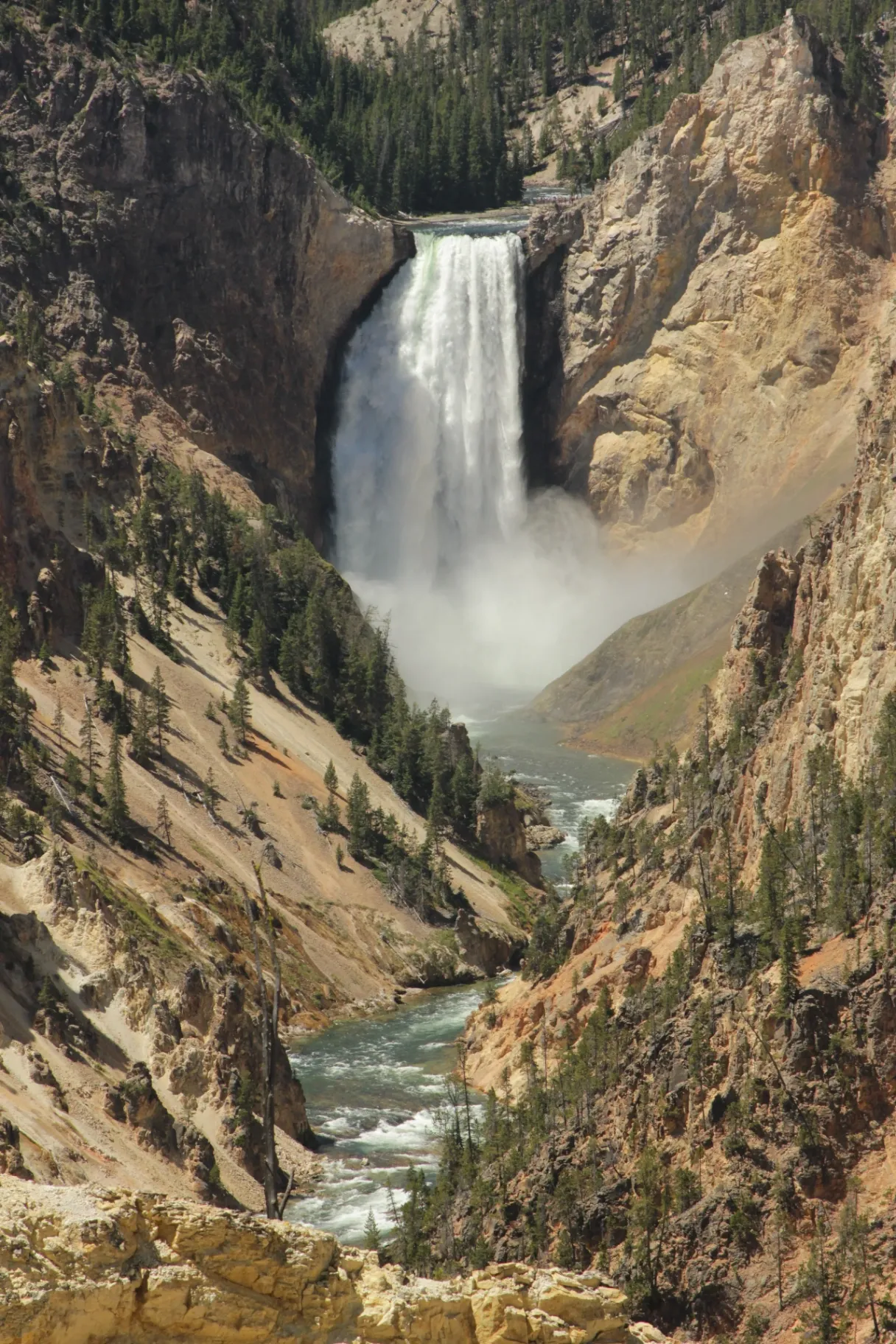
What "Open" Really Means in Spring
When the NPS announces a road is "open," that means the road is plowed and passable. It does not mean the full Yellowstone experience is waiting for you. Here's what to realistically expect:
- Lodges and restaurants may not be operating yet — many open in late May
- Restroom facilities may be limited to vault toilets at some locations
- Snowbanks of 5–10 feet may line the road, blocking some pullouts
- Hiking trails at higher elevations may still be snow-covered and impassable
- Campgrounds open on staggered dates — most aren't available until late May or June
- Gas stations inside the park may not be operational in early season
- Cell service is extremely limited throughout the park, regardless of season
🎒 Pack Your Own Supplies
For early spring visits, bring food, water, extra layers, and a full tank of gas. Don't rely on in-park services being available. See our Weather & Packing Guide for a complete spring checklist.
Do You Need AWD, 4WD, or an SUV?
No. All main park roads are paved, two-lane highways accessible to standard passenger vehicles from May through October. A sedan, minivan, or compact car will get you everywhere you need to go.
Early Spring Nuances
- Early May mornings can have icy patches, especially on shaded road sections above 7,500 ft
- Sudden spring snowstorms can drop several inches in hours at higher elevations
- Beartooth Highway traverses alpine terrain where conditions can be winter-like even after opening
- AWD provides added confidence but is not required for any paved park road
If you're renting a car, any standard vehicle will work. See our Getting Here guide for driving tips.
Wildlife Traffic Jams
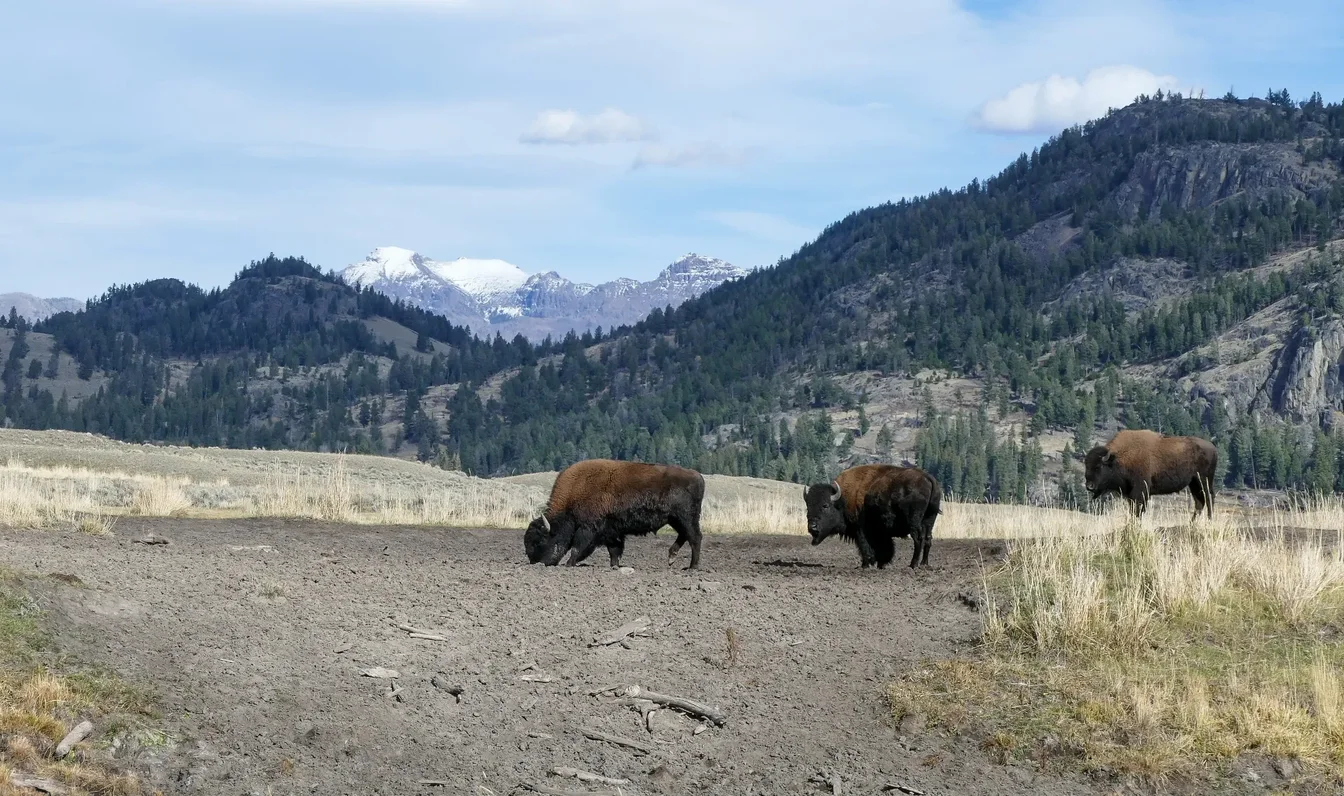
If there's one thing that catches first-time visitors off guard, it's the wildlife-induced traffic jam. When a bison herd crosses the road, a grizzly is spotted near a pullout, or wolves are visible in Lamar Valley — traffic stops.
What Causes Wildlife Jams
- Bison herds using the road as a travel corridor (most common, especially in Lamar and Hayden valleys)
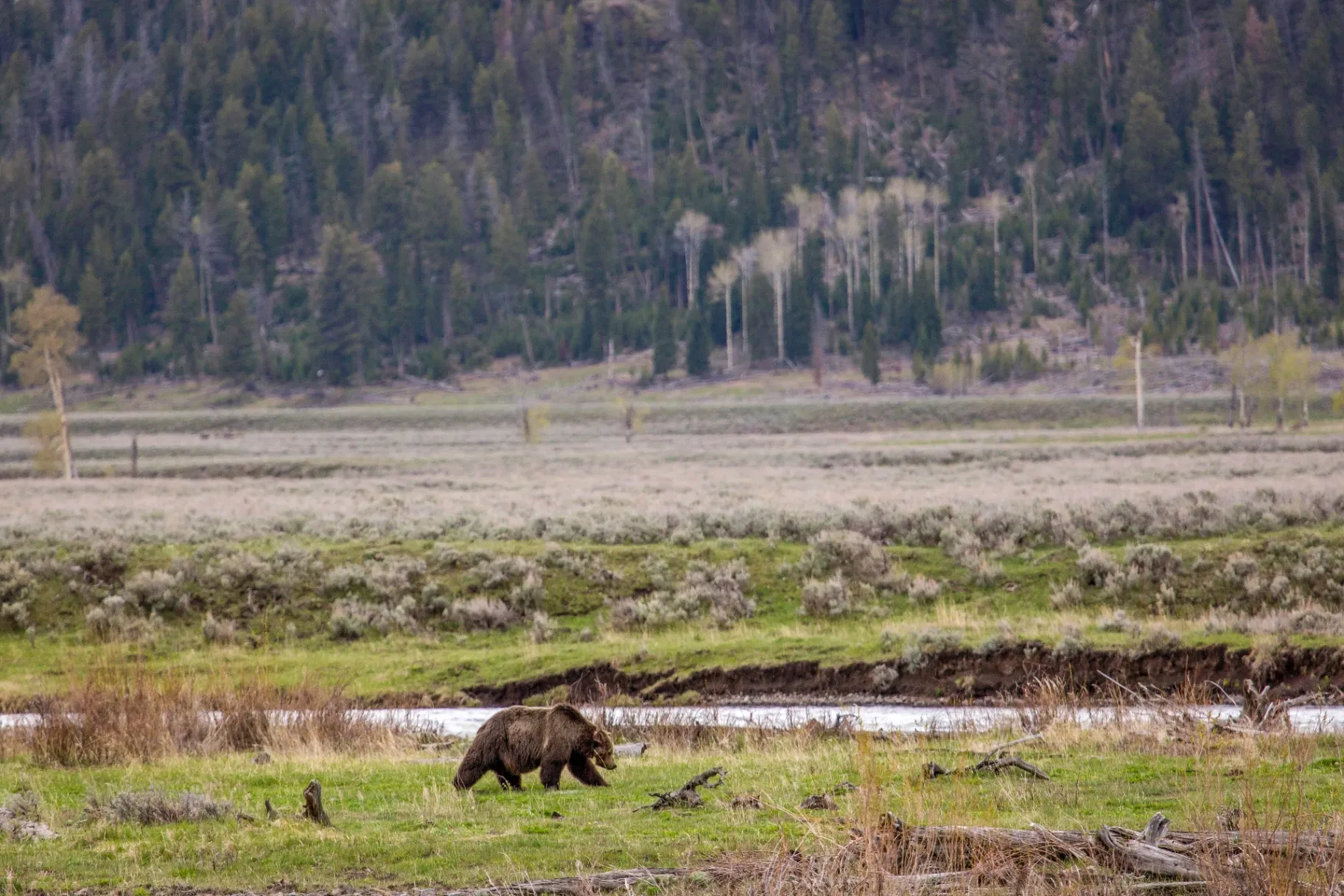
- Bears foraging near roadsides in spring — Dunraven Pass and Tower-Roosevelt are hotspots
- Wolf packs visible from roadside pullouts, drawing photographers with spotting scopes
- Elk crossing roads near Mammoth Hot Springs and Madison River
- Moose in riparian areas near bridges and river crossings
Etiquette & Safety
- Stay in your vehicle during roadside wildlife encounters
- Maintain 100 yards from bears and wolves, 25 yards from bison and elk
- Do not honk, rev engines, or attempt to move animals off the road
- Pull fully off the road if you stop — don't block traffic in the travel lane
- Rangers actively enforce wildlife viewing distances and may issue citations
Wildlife jams are part of the Yellowstone experience — embrace them. For a full species-by-species breakdown, see our Yellowstone Wildlife Guide. For safety rules, visit our Safety page.
Beartooth Highway
The Beartooth Highway (US-212) connects Red Lodge, Montana to the Northeast Entrance of Yellowstone, climbing to nearly 10,947 feet at Beartooth Pass. Charles Kuralt called it "the most beautiful drive in America."
Opening Timeline
The Beartooth typically opens between late May and mid-June, making it consistently the last route into Yellowstone each spring.
- Snowpack at the summit regularly exceeds 15 feet
- Even after opening, conditions can be winter-like with ice, fog, and sudden whiteouts
- The highway closes in mid-October and remains closed through winter
- No services or gas stations along the 68-mile route between Red Lodge and Cooke City
- Motorcyclists and RVs should check wind advisories before attempting the pass
💡 Pro Tip: Combine with Lamar Valley
If the Beartooth is open, enter through the Northeast Entrance and drive through Lamar Valley — the best wildlife corridor in the park. The combination of alpine scenery and wildlife is unmatched.
Spring Travel Planning Tips
Visiting Yellowstone in April or May requires more planning than a peak-summer trip, but the rewards — fewer crowds, active wildlife, dramatic landscapes — are substantial.
⏰ Arrive Early
Arriving before 8:00 AM gives you the best wildlife viewing and parking availability. Animals are most active at dawn.
🌡 Layer Up
Spring temperatures can range from 20°F at dawn to 60°F by afternoon. Dress in layers and keep a warm jacket in the car. See our packing guide.
⛽ Top Off Your Gas
In-park gas stations may not be operational in early spring. Fill up before entering. West Yellowstone and Island Park have full services.
🔭 Bring Optics
Spring wildlife is active but can be distant. Binoculars are essential; a spotting scope dramatically increases your chances of quality wolf and bear sightings.
📍 Check Daily Conditions
Visit nps.gov/yell every morning. Roads can close or open with little notice.
🚧 Expect Construction
Spring is also construction season. Expect temporary delays and flaggers on some road segments. Patience is key.
Where to Stay for Spring Access
During spring's phased openings, your lodging location directly impacts what you can access. Since the West Entrance opens first among seasonal entrances, staying near it provides the widest range of options earliest in the season.
West Entrance Advantages
- First seasonal entrance to open — third Friday in April
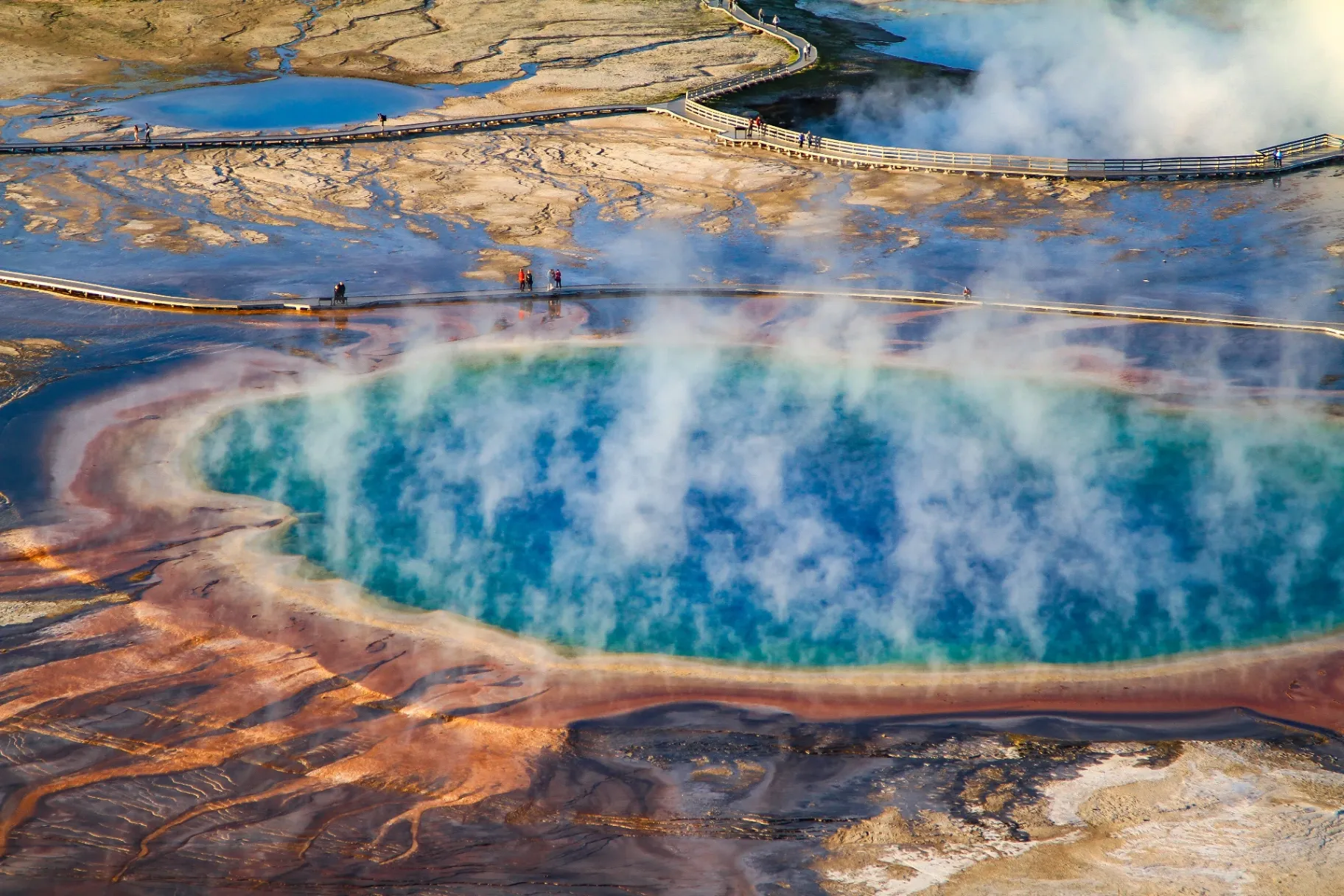
- Immediate access to Old Faithful, Grand Prismatic, Norris Geyser Basin
- Shortest drive from lodging to the park's most iconic geothermal features
- Island Park, ID is 45 minutes from the West Entrance with full services
- Less congested than peak-season — enter before other visitors arrive
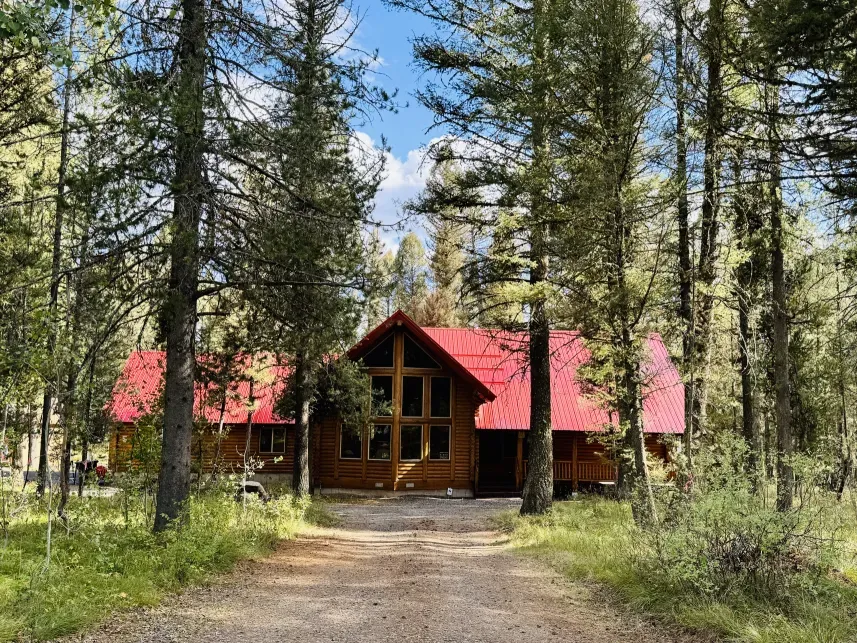
Our cabin in Island Park sleeps up to 12 guests and sits just 45 minutes from the West Entrance. For a comparison of all gateway towns, see Island Park vs. Border Towns.
Frequently Asked Questions
When do Yellowstone roads open?
Most roads open in phases between mid-April and late May. The West Entrance corridor typically opens first (third Friday in April). The road between Mammoth Hot Springs and Cooke City is open year-round.
Is Yellowstone open in May?
Yes, but with limitations in early May. Some roads (Dunraven Pass, East Entrance) may not be open yet. Services and lodges open on staggered schedules. By late May, most of the park is fully accessible.
Is Beartooth Highway open in May?
Usually not until late May at the earliest, often not until June. The highway reaches nearly 11,000 feet and requires extensive plowing.
Do I need AWD or 4WD?
No. All main park roads are paved and accessible to standard passenger vehicles from May through October. AWD adds confidence in early spring but is not required.
Which entrance opens first?
The North Entrance (Gardiner, MT) is open year-round. Among seasonal entrances, the West Entrance (West Yellowstone, MT) typically opens first.
Can roads close after they open?
Yes. Spring storms can temporarily close roads for safety. Always check the NPS road status page the morning of your visit.
Are roads icy in May?
Possible, especially in early May at higher elevations like Dunraven Pass (8,859 ft) and Craig Pass. Morning temperatures can drop below freezing. Drive cautiously.
Plan Around the Roads, Not Around the Calendar
Yellowstone's roads open in stages each spring. Understanding what that means — and planning around conditions rather than fixed dates — turns uncertainty into opportunity. Fewer visitors, active wildlife, dramatic snowmelt landscapes, and the raw energy of a park waking up from winter make spring one of the most rewarding times to visit.
Check the schedule. Watch the conditions. Pack layers. And get there early.
Ready to plan your spring trip? See our 3-Day Yellowstone Itinerary for a day-by-day plan, or explore our Summer Activities and Hiking guide for what awaits once the roads are fully open.