 (source: nps.gov)
The Image as Witness
In 1871, almost no one in Washington, D.C. believed the stories drifting back from the Yellowstone Plateau. Geysers shooting two hundred feet into the air? A canyon painted yellow and red? A lake higher than most mountains? Earlier expedition reports had been dismissed as tall tales.
What changed in the winter of 1871–72 was photographs. When Ferdinand Hayden brought back William Henry Jackson's glass-plate negatives and Thomas Moran's watercolor sketches, the entire conversation shifted. Within months, Congress voted to set aside more than two million acres as a public park — the world's first.
Yellowstone was, in a very real sense, the first national park created by photography.
William Henry Jackson: The Man with the Mules
William Henry Jackson was 28 when Hayden hired him as the official photographer of the 1871 U.S. Geological Survey. His "darkroom" was a canvas tent strapped to a mule. His camera produced glass negatives up to 11 by 14 inches. Each exposure required coating a plate with sticky chemicals, exposing it inside the camera while still wet, and developing it within fifteen minutes — all in the field.
Jackson's Yellowstone Equipment, 1871
- • Two large-format cameras (8×10 and 11×14 inch glass plates)
- • A stereoscopic camera for double-image novelty prints
- • A portable wet-plate darkroom tent
- • Roughly 400 pounds of glass, chemicals, and gear
- • One pack mule named "Hypo" (after photographic fixer)
His prints toured congressional offices through the winter of 1871–72, and members of the House and Senate held them in their hands while debating the bill that would create Yellowstone National Park.
Thomas Moran's Paintings: Color the Camera Couldn't Capture
Photography in 1871 was black and white. Yellowstone is not. Thomas Moran, an English-born painter, joined the 1871 Hayden survey and traveled side-by-side with Jackson, sketching constantly. His later studio painting The Grand Canyon of the Yellowstone, completed in 1872, was seven feet by twelve. Congress purchased it for $10,000 and hung it in the Capitol.
Photographs proved Yellowstone existed. Paintings proved it was beautiful enough to save.
F. Jay Haynes: Yellowstone's Official Photographer
Frank Jay Haynes built his career on the Northern Pacific Railroad. By 1884 he had been appointed Yellowstone's official photographer, a position he and his son Jack would hold for the next 84 years. Where Jackson had captured Yellowstone for Congress, Haynes captured it for tourists, arriving just as the Northern Pacific began bringing the first wave of visitors to Mammoth.
The Haynes Picture Shops
 (source: nps.gov)
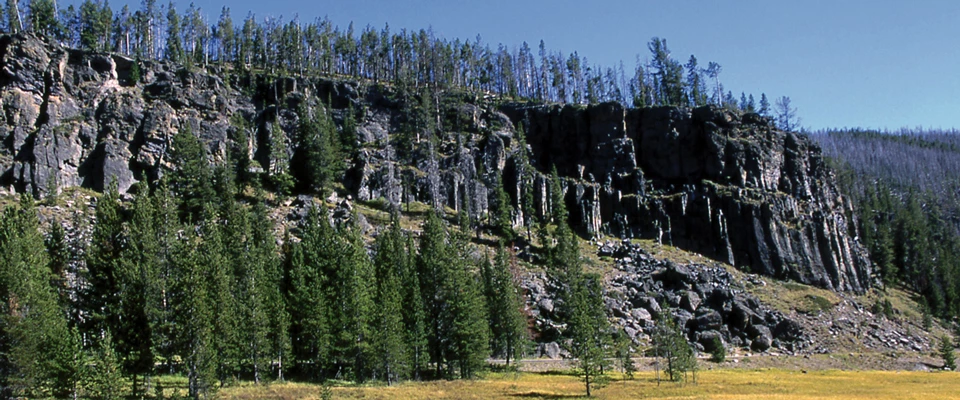
Early-era Yellowstone — captured by F. Jay Haynes and sold by the thousand at Haynes Picture Shops
Starting in the 1880s, Haynes opened "Picture Shops" at every major stop on the stagecoach Grand Loop: Old Faithful, Mammoth, Canyon, Lake, and West Thumb. By the 1910s there were a dozen of them. Each sold prints, postcards, stereographs, hand-tinted lantern slides, and the famous Haynes Guide.
Haynes also pioneered winter travel into the park. In 1887 he led a ski expedition through Yellowstone in January, returning with the first winter photographs ever made.
The Haynes Empire
- • Official photographer: 1884–1921 (F. Jay), 1916–1967 (Jack E.)
- • Picture Shops at peak: 12 locations
- • Postcards printed: Tens of millions
- • Editions of the Haynes Guide: 65+ between 1890 and 1966
- • Archive today: Montana Historical Society — 25,000+ negatives
Stereographs, Postcards, and the Yellowstone in Every Parlor
Long before color photography, the stereograph was the dominant form of mass-market visual entertainment in America. Yellowstone was perfect material — Haynes, Jackson, and dozens of other publishers churned out cards by the millions. By the 1890s, almost every middle-class American parlor had a stereoscope and a wooden box of cards. For the average citizen who would never travel west, the park existed entirely as a 3D illusion in their living room.
The picture postcard arrived around 1900 and quickly displaced the stereograph. Haynes printed Yellowstone postcards by the tens of millions through the early 20th century, keeping the park's image circulating constantly through American culture.
Early Wildlife Photography
Photographing live animals with a wet-plate camera was essentially impossible. That changed with dry-plate film in the 1880s and faster shutter speeds in the 1890s. These early wildlife images later became important evidence in the campaign to save Yellowstone's wildlife from poachers. Photographs of one specific bison killed by the notorious poacher Ed Howell in 1894 led directly to the Lacey Act of 1894 — the first real legal protection for park wildlife.
Kodak Arrives: The Tourist with a Camera
In 1888, George Eastman released the first Kodak: "You press the button — we do the rest." For the first time, ordinary tourists could take their own photographs. By the 1890s, Yellowstone visitors were arriving with box cameras of their own. Haynes responded brilliantly: he opened developing services in his Picture Shops, offering same-day processing for tourist film.
Photography as a Tool of Preservation
The Yellowstone story established a pattern repeated for every major American conservation victory since. Photographs created Yosemite, the Grand Canyon, the redwoods, the Everglades, the Tetons, and the Arctic National Wildlife Refuge. The basic logic — see this place, you cannot let it be destroyed — was tested and proven first in Yellowstone in 1871.
Ansel Adams's own Yellowstone work, made for the Department of the Interior in 1942, deliberately echoed Jackson's vantage points — sometimes setting up his tripod in the same spots, 70 years later.
Where to See the Originals Today
Most of the great early Yellowstone photographs are now public domain, digitized, and free to view online. The Library of Congress, the U.S. Geological Survey Photo Library, and the National Park Service all maintain searchable archives. The Montana Historical Society in Helena holds the largest collection of original Haynes negatives — more than 25,000 of them.
In-Park Places to See Historical Photography
- • Albright Visitor Center, Mammoth: Original Jackson and Haynes prints on permanent display
- • Old Faithful Inn lobby: Historic Haynes images of the Inn's construction
- • Museum of the National Park Ranger, Norris: Haynes guides and field cameras
- • Heritage & Research Center, Gardiner: The park's main archive (by appointment)
For visitors who want to follow in the footsteps of Jackson and Haynes, our Yellowstone photography guide covers the same vantage points — Artist Point, Inspiration Point, the Lower Geyser Basin, and the Mammoth Terraces — that defined the park's visual identity 150 years ago.